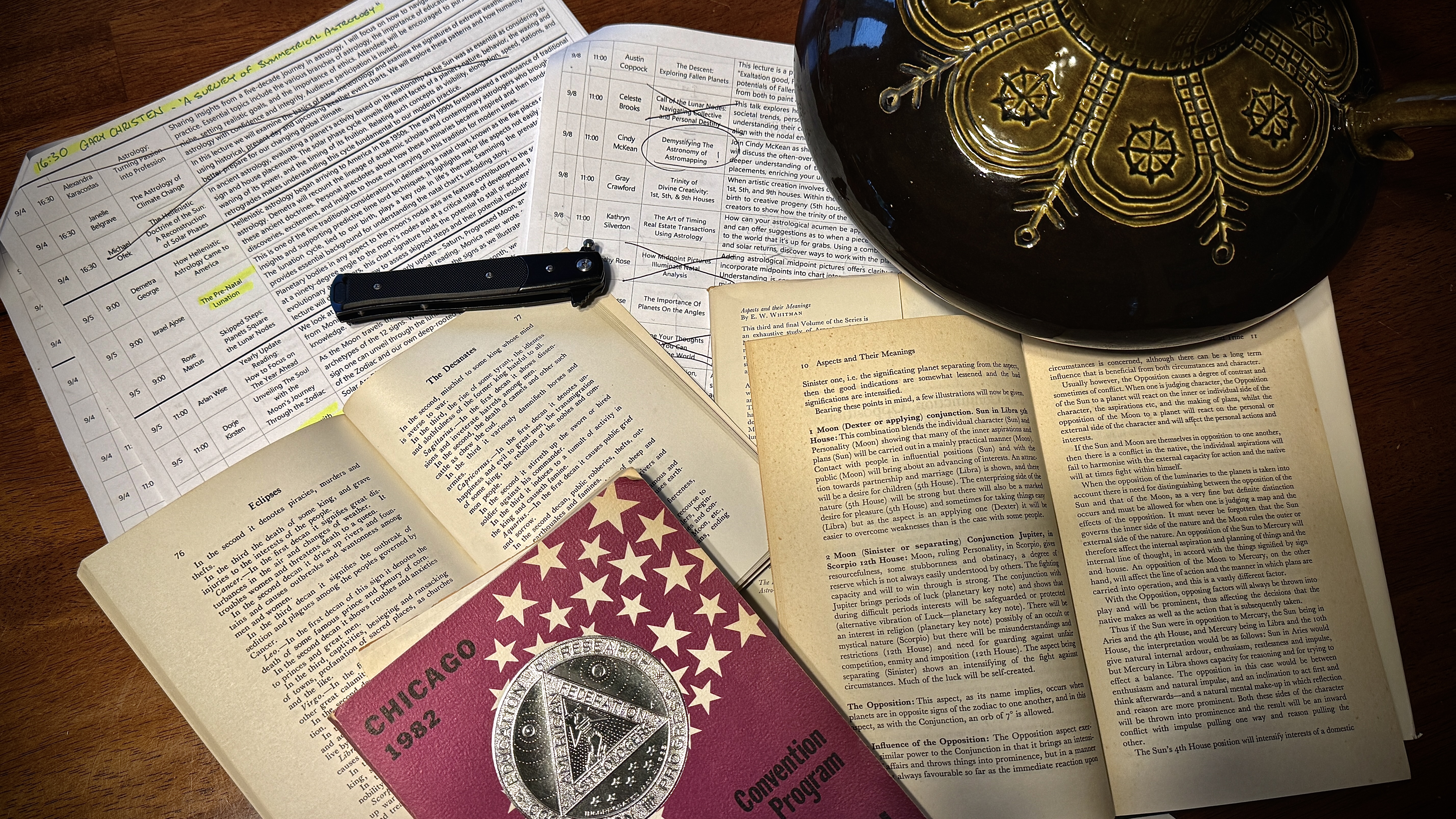
I have been losing sleep over a spreadsheet. Four spreadsheets, actually. They all look pretty similar.
Not a budget spreadsheet. Not a work deadline. A spreadsheet of astrology seminars. Over 350 sessions across five days and I need to pick one per time slot. One. Out of seven or eight or more options running simultaneously. I have edited this spreadsheet an inordinate number of times. I’ve color-coded it, un-color-coded it, re-color-coded it with different colors, added a weighted column for “interest level”, deleted the column, added it back. I’ve moved a session from “locked” to “maybe” at 6:00 before finally collapsing in bed and then promptly moved it back later that morning while brushing my teeth.
It’s been two weeks of this. Two weeks of staring at session titles and speaker bios and trying to predict which 75 minutes of my life will matter most in retrospect. Given my personal brand of neurodivergence, this type of decision paralysis isn’t new… but it’s usually about dinner or which of the four projects I started today to continue working on. This feels frustratingly different. This feels like the stakes are real because… they are? I am investing a significant sum of money on this foray and delaying my [hopeful] start date of a new job by several weeks because in order to attend and that’s not even to mention that this conference which takes place every 3-4 years hasn’t happened in EIGHT YEARS. Last time UAC took place I didn’t even know what my moon sign was. These sessions have me fucking flummoxed.
I asked the members of my astrology study group to look over the list and I reached out to some of the people I’ve recently connected with for advice; new associates in this field who I respect and who have been to one [or many] of these before.
And then, at a certain point... I just made the fucking decisions. Not because I reached some zen clarity. Because I ran out of time to keep agonizing and was just over it. I sat down, went slot by slot, and committed. Is it perfect? No. I mean, I don’t know… maybe it’s perfect? It’s done, I know that. Did I waste time I could have spent on other things [exam prep, perhaps]? Goddamnit. Yes I diddddd… but the decisions are (finally) made, the spreadsheet is locked, and I’m moving forward.
The Sky Had Opinions, As Usual
Generally speaking, I have gotten better at managing this super fun nuance of my brain but, holy shit, did this decision debacle derail my derelict medulla.
August’s astrology was a pileup. Several patterns stacked on top of each other in a way that turned normal decision-making into something genuinely exhausting.
Mercury was in Leo, which means the mind wants every choice to feel creative and important. So instead of “which seminar fits this time slot,” the question becomes “which choice says the most about who I am and where I’m going.” That’s a different question. That’s a much harder question [lolz].
Mercury opposed Pluto on August 11th. That’s the obsessive layer. The “I need to see every angle before I commit” part [no, I mean even moreso than usual]. One does not simply pick an option anymore... no, you’re now trying to avoid making the wrong life turn. Normal decisions start feeling like they have hidden consequences.
That very same day Mercury trined Neptune. This made everything feel more symbolic and intuitive but also foggier. There must be a right answer. You can almost feel it. But you can’t quite see it clearly enough to grab it. Two aspects, same night, stacking on each other within a few hours.
Mars squared Neptune on the 17th. That’s low-traction effort. You’re working hard. You’re organizing, comparing, researching, building spreadsheets but it feels downright Sisyphean at times. You’re doing a lot and the work isn’t producing certainty.
Venus opposed Saturn on the 21st. Every choice has a cost. Stern. Choosing this means giving up that [yuck]. Venus in Libra wants the elegant solution where nothing gets lost. Saturn in Aries says no. A real choice means accepting limits and that can certainly spike the cortisol in the ADHD brain.
And all of this was happening during eclipse season (solar eclipse in Leo on August 12th, upcoming lunar eclipse in Pisces on August 27th), which functions like a background hum of instability and transition. So the decisions don’t feel casual. They feel heavier than they should, more symbolic, more tied to whatever comes next.
It’s like trying to pack for a major trip while moving apartments during a thunderstorm. You’re not just asking “should I bring this shirt.” You’re tired, overstimulated, emotionally attached to certain things, worried about forgetting something important, and aware that every item you pack means leaving something else behind. The shirt becomes a proxy for a much bigger feeling: am I prepared for what’s next?
Most people would flatten this into “Mercury made you overthink” or “eclipse season made everything chaotic.” That’s too simple. Each transit describes a different layer of the experience.
- Mercury in Leo: the choice feels meaningful.
- Mercury opposite Pluto: the choice feels obsessive.
- Mercury trine Neptune: the choice feels symbolic but unclear.
- Mars square Neptune: the effort feels foggy and low-traction.
- Venus opposite Saturn: the choice has real limits and costs.
- Eclipse season: the whole thing feels transitional.
This is not “the planets made you indecisive.”
I read it as the astrology describing why the decisions felt bigger than simple logistics. These decisions I was facing were colored with an undercurrent of trade-offs, sacrifices, and direction.
Soooo, You’re Probably Desperately Curious To Know What I’m Actually Attending
Here’s where I landed (along with some of my personal top alternative picks). Five days, roughly five sessions per day. I’m listing what I locked in, why, and what I’m hoping to catch on recording afterward… I’m leaving myself some runway for game-time-decisions, of course. If you’re attending UAC and our lists overlap (or, better yet, diverge) I want to hear from you! More on that at the end.
Friday, September 4th
9:00 AM: Frank Clifford, “The MC-IC Axis, the Zenith and the Nadir”
This is the kind of foundational session that I think gets overlooked because it sounds basic. It’s not. If you use Equal or Whole Sign houses, the MC-IC axis floats... it doesn’t begin the angular houses the way it does in quadrant systems. That means there are two further reference points, the zenith and nadir, that most introductory texts either gloss over or ignore entirely. Clifford is one of the most respected educators in the field and he’s specifically promising to show how to use and interpret those degrees in practice. Starting the conference here felt right.
Alternative pick: Bruce Scofield, “Theories of Astrology”
11:00 AM: Laurence Hillman, “Astrology and AI: Embracing Uranus Without Losing Your Soul”
Given that I just wrote an entire article about astrology and AI... this one seems non-negotiable. I reached out to Hillman ahead of the conference and he clarified something important: this isn’t a talk about practical AI tools and it isn’t a philosophical pros-and-cons analysis. He’s approaching AI phenomenologically… as a new hugely Aquarian phenomenon that is here to stay and that is changing all of us. The question he’s asking is how do you stay human in that? How do you not lose your soul [or become a killer cyborg!]? How does activating your Uranus help you respond to a new era? He also made a point that I’ve been ruminating on: we each respond to AI according to our own astrology. One size for all is an illusion. That reframes the whole conversation in a way I hadn’t previously considered.
Alternative pick: Lynn Bell, “The Times of Our Life: Breaking Through”
1:00 PM: Julie Starr, “When a Benefic Isn’t So Great”
Jupiter and Venus are just “good” and that’s that, right? If you’ve studied astrology more in depth you know it’s… more complicated than that. Starr is breaking down specific techniques for identifying when benefics aren’t actually beneficial in a client’s chart... the kind of delineation nuance that separates “I read your Sun sign” from actual practice. Chart examples included. This is the stuff that doesn’t fit on an Instagram infographic.
2:30 PM: Alan Annand, “Mutual Reception: The Power of Sign Exchange”
43% of horoscopes feature mutual reception using traditional rulerships, and yet it remains one of the least understood patterns in astrology. William Lilly stressed its importance. Modern astrologers have taken little note. There are 66 combinations under three main classes, each with a broad prognosis. Annand is working with example charts of astrologers like Sydney Omarr, Olivia Barclay, and Dane Rudhyar. I am particularly interested in this as a springboard to gaining greater understanding of my personal placements of Mars and Venus being in mutual reception.
Alternative pick: Gary P. Caton, “The Twelve Mercury Elemental Year Returns”
4:30 PM: Gary Christen, “A Survey of Symmetrical Astrology”
Uranian/Symmetrical astrology is a system I know almost nothing about, and that’s exactly why I’m going. The session covers everything from the history and use of tools like 360 and 90 degree dials, Polar Azimuthal Projection, and Graphic Ephemerides to the philosophical basis underlying the whole system. Christen calls it “the wave of the future” and says it’s suitable for all astrologers. One of my goals for UAC is to leave with at least one completely new framework rattling around in my brain. This might be it.
Saturday, September 5th
9:00 AM: Israel Ajose, “The Pre-Natal Lunation”
One of the five traditional “places of life” in natal delineation... the lunation cycle tied to your birth that highlights major life themes not easily visible at first glance. It also supports predictive time lord techniques, which is directly relevant to the exam I’m taking on the last day. Exam prep meets genuine curiosity.
Alternative pick: Demetra George, “How Hellenistic Astrology Came to America”... and yes, it hurts to miss that one.
11:00 AM: Meira Epstein, “Predicting with Solar Arc Direction”
Solar Arc is a predictive technique I’ve yet to utilize. Epstein calls it “the technique with the most precision” and notes it’s the preferred method in Uranian astrology (which ties nicely into Christen’s session from Friday). She’s comparing it directly with Secondary Progressions and Transits and demonstrating an integrated approach to predictive work in general. Efficient education from someone whose reputation precedes her [to say the least].
Alternative pick: Austin Coppock, “Four Elements, Four Epochs”
1:00 PM: Katia Perez Fuentes, “Advanced Astrology for Frequent Travelers”
A survey of relocation techniques exploring what it means to be transient in a rapidly shifting global landscape, building on the foundational work of Jim Lewis’ A*C*G and Cyclo*Carto*Graphy with contemporary advancements. This one connects directly to a project I’m building: a computational city ranker that combines astrocartography with real-world location data.
2:30 PM: Julija Simas, “Astro-Mapping: Geodetic, A*C*G, Local Space and Sacred Maps”
This one breaks down the differences between three distinct mapping systems: Geodetic maps (fixed zodiac system projected onto the world map), A*C*G maps (natal charts projected onto the world map... a more recent development), and Local Space maps (planetary lines cast onto the horizon from a central point). How to use them together, how to use them for different purposes. Research fuel.
4:30 PM: Moses Siregar, “Locational Astrology’s Missing Link: How to Understand Relocated Charts with Accuracy and Precision”
Yes, that’s three locational astrology sessions in one day. I’m building something in this area and I need the technical depth. Siregar’s approach is grounded in studying over 20,000 relocated charts where his clients had already lived. His Triangulated Houses method uses Equal, Porphyry, and Whole Sign simultaneously, transforming the houses into a three-dimensional space rather than a flat one. That’s exactly the kind of multi-perspective, data-backed methodology I’m drawn to and goddamn is Siregar’s data pool impressive!
Alternative picks: Deborah Houlding, “Celestial Influences: United Principles of Motion & Light” · Patrick Watson, “Twilight Sects”
Sunday, September 6th
9:00 AM: Kathy Allan, “Invisible Points of Power: Finding and Using Antiscia and Arabic Parts”
Deep traditional technique territory. The seven traditional Arabic Parts define alternative placements of the seven traditional planets. Antiscia are shadow placements. When either of these form conjunctions and oppositions to physical planets, they illuminate significant hidden connections you wouldn’t otherwise see.
Alternative picks: Nick Dagan Best, “Planetary Synodic Cycles Combinations: Merging Forces” · Demetra George
11:00 AM: Ronnie Gale Dreyer, “Timing is Everything: Astro*Carto*Graphy in Action”
Locational astrology session number four! Dreyer worked with Jim Lewis himself; tough to top that! Cyclo*Carto*Graphy adds timing techniques to A*C*G maps... the “where and when” together.
Alternative pick: Frank Clifford, “Forecasting Strategies”
1:00 PM: Amy Angelo, “Mercury as a Functional Malefic”
This pairs nicely with Starr’s benefic talk from Friday. Mercury’s role in Hellenistic astrology as an ambivalent figure capable of doing good, causing harm, or embodying both simultaneously.
2:30 PM: Amélie Gebhard, “Hilma af Klint: A Cosmic Cartography”
This is my wildcard. Hilma af Klint was a Swedish artist who was creating abstract art before Kandinsky, before Mondrian, before anyone in the Western canon was given credit for it. She worked from spiritual revelation and her paintings are staggering. Gebhard is weaving natal chart, transits, progressions, and generational signatures to trace how af Klint translated revelation into a visionary visual language... bridging the material and the invisible. Also promises practical tools for chart analysis, intuitive synthesis, and understanding vocation. I also happen to love Northern European painters; I’m in.
Alternative picks: Nadia Anderson, “Drawing Down the Moon: Eclipse Prediction & Astrology’s Lost Histories” · Baris Ilhan, “Mercury, Mars & Venus: The Inner Planets as Agents for Self-Actualization”
4:30 PM: Bear Ryver, “Another Method for Years from Seuthes, the School of Hermeias”
Vettius Valens handed down several powerful timing techniques in the Anthologies. Profections get attention because they’re easy and purely symbolic. Zodiacal Releasing gets attention because it’s grounded in astronomy (but clunky to mentally calculate beyond the level of months). And then there’s Seuthes’ method for years. Easy to calculate, rarely talked about. Ryver promises you’ll walk away with “a new tool for harvesting interpretive juice down to the wee hours.” That’s the kind of session I want at UAC... the thing I didn’t know existed before I read the schedule.
Alternative picks: Bruce Scofield, “Research on the Synodic Cycle of Venus” · Madalyn Hills-Dineen, “Creating Successful Electional Charts”
Monday, September 7th
9:00 AM: Kelly Surtees, “Work With Fortune and Spirit: Explore Hidden Potential and Core Purpose in a Birth Chart”
The Lots of Fortune and Spirit are foundational in Hellenistic astrology. Surtees is covering how they change the quality and function of a house or planet, how Fortune adds special potential to specific houses, and how Spirit can describe a deeper purpose in the chart. She’s also getting into the Place of Acquisition and of Fame. Surtees is one of the clearest communicators in the field and this is the kind of session where I expect to walk out with immediately applicable knowledge.
Alternative picks: Martin Sebastian Moritz, “The Mysterious 8th House: Opening Pandora’s Box” · Douglas Noblehorse, “The Flight of the Chariot: Focusing on Valens’ Four Sun-Moon Lots” · Elena Lumen, “Predictive Methods of Arabic Astrologers: Secrets Revealed”
11:00 AM: Antje Sommer, “The Power & Limitations of AstroCartoGraphy”
Locational astrology session number five. Yes, five. Sommer is teaching the fundamentals while also highlighting some myths of AstroCartoGraphy. “You will walk away with all the tools you need to dive into the subject.” What sold me is the explicit focus on limitations. When you’re building computational tools in this space as I am, knowing where the technique breaks is as important as knowing where it works.
1:00 PM: Drew Levanti, “Turn by Turn: Eventful Mixtures in Annual Profections”
Planetary aspects have delivery dates... specific years in life when the aspect’s promise ceases to be latent and manifests in full force. Every aspect is a two-way street with two distinct modes of manifestation. Profections are already central to my study; this is the advanced layer that reveals when the chart’s promises actually show up.
2:30 PM: Mark Urban-Lurain, “The History of Skepticism and Astrology”
This might surprise people. I chose a session about skepticism at an astrology conference. Urban-Lurain is examining the historical and philosophical origins of skepticism and offering a framework for understanding modern skepticism as it pertains to astrology, including the controversies with organized skeptics over the Gauquelin Mars Effect and other astrological research. If I’m going to make the case for astrology as a serious discipline, I feel compelled to understand the strongest arguments against it; I’m really excited about this one.
Alternative pick: Lynn Bell, “Mad, Bad, and Dangerous to Know”
4:30 PM: Rick Levine, “The Planetary Odd Couple of Mercury and Pluto”
Levine is one of the panelists I listened to at Lily Dale this past week. I can tell you from firsthand experience that the man can hold a room but, if you consume any amount of astrology-focused media you probably already knew that. Mercury is often dismissed as a planetary lightweight, but Hermes served as a psychopomp... a guide of souls journeying into the Underworld. Levine is exploring Mercury’s complex archetype, its psychedelic functions, and its role in individual shadow work. Recovering our “Persephone-like abducted thoughts” through talk therapy. Groovy.
Alternative picks: Mark Jones, “The Perfect Circle: The Nature of Aspects” · Dorian Greenbaum, “Planetary Lots: Their History and Use”
Tuesday, September 8th
9:00 AM: Nadiya Shah, “Chiron in Taurus 2026-2033”
Chiron entering Taurus is a major transit for the next several years. Shah is exploring key myths surrounding Chiron and what they tell us about collective implications, including Chiron’s role in the Great Sextile (the most important major configuration of the decade) and the Chiron-Pluto square, which suggests that embracing Chiron’s wisdom might first require an awareness of how deep those collective wounds go. Big-picture astrology. I want to start the final day with a wide lens.
11:00 AM: Austin Coppock, “The Descent: Exploring Fallen Planets”
I guess the event organizers really wanted to end the seminar blocks with a bang. This is my near game-time decision and, even then, I had to narrow these two choices down from a pool of 8 seminars during this time slot that I had ample interest in. From what I have read, Coppock is one of the most interesting thinkers in contemporary astrology and his pitch is a detailed survey of the qualities, pitfalls, mitigations, remedies, and hidden potentials of fallen planets, drawing on both Vedic and Western traditions to paint a fuller picture. “Moving beyond ‘Exaltation good, Fall bad.’” The alternative is Cindy McKean’s “Demystifying the Astronomy of Astromapping,” which covers local space, the celestial sphere, and the astronomical characteristics of planets... that would round out my locational stack nicely. But Coppock wins, I think. Probably… We’ll see how I feel that morning.
4:00 PM: Closing Ceremony & In Memoriam
Wednesday, September 9th: NCGR-PAA Level I Certification Exam
What I’m Catching on Recording
I want to be transparent about the sessions I’m not attending live but plan to watch after the conference. In some time slots, the decision came down to a coin flip:
Bruce Scofield’s “Theories of Astrology” [9/4], Lynn Bell’s “The Times of Our Life” [9/4], Gary P. Caton’s “Mercury Elemental Year Returns” [9/4], Demetra George’s “How Hellenistic Astrology Came to America” [9/5], Rory Keys’ “The Lot of Exaltation” [9/5], Deborah Houlding and Patrick Watson [9/5], Frank Clifford’s “Forecasting Strategies” [9/6], Nadia Anderson and Baris Ilhan [9/6], Georgia Stathis’ “Rulerships: A 3-D Approach” [9/7], Lynn Bell’s “Mad, Bad, and Dangerous to Know” [9/7], Mark Jones and Dorian Greenbaum [9/7].
That’s eleven sessions on my recording wish list. Some of those hurt more than others.
An Open Invitation: Let’s Share Notes
Here’s the thing about picking one session per time slot: someone in the room next door is hearing the thing you missed. And you’re hearing the thing they missed.
So I have a proposal for any UAC attendee reading this. If you’re going to sessions I’m not attending and I’m going to sessions you’re not attending... let’s trade notes! I don’t mean formal transcriptions. I mean: what was the thing you wrote down and underlined twice? What surprised you? What changed how you think about something?
I am genuinely interested in building a small, informal group of attendees who want to share their highlights after the conference. Whether our session picks overlap (we can compare what we each took away) or diverge (we can fill each other’s gaps)... I think both are valuable.
If you’re interested, I’ll have more details on how to connect closer to the conference. Keep an eye on AstroRot’s Instagram for updates. If you want to reach out directly, I’m at astrorot716@gmail.com.
We’re all going to miss something. Let’s make sure none of us miss everything.